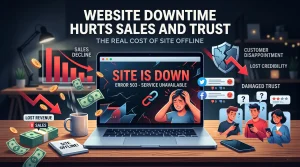
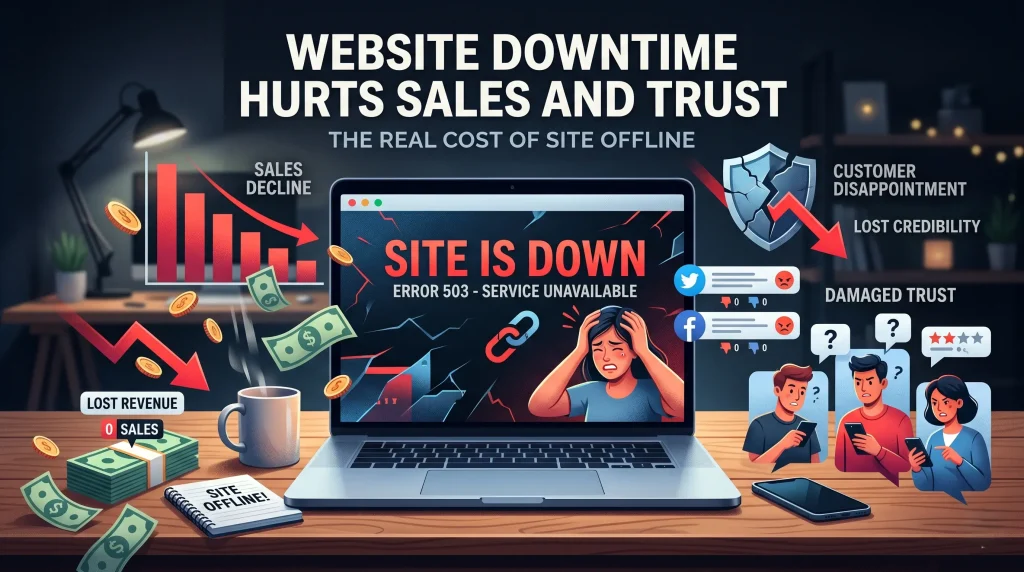
A potential customer clicks on your ad, ready to make a purchase. They land on your URL, but instead of a beautifully designed storefront, they see a blank page and a “Server Not Found” error. Within seconds, they close the tab and move to a competitor. This scenario happens thousands of times a day across the internet. It represents the silent killer of online business: website downtime.
When your website goes offline, your business essentially shuts its doors to the world. It stops generating leads, processing transactions, and serving your audience. Preventing this catastrophic failure requires robust hosting and proactive monitoring. This is where HostOrbis steps in. By providing resilient infrastructure and continuous oversight, HostOrbis ensures your digital storefront remains open around the clock.
Website downtime significantly impacts sales and erodes customer trust. Protecting your online assets with a reliable hosting partner is no longer optional—it is a fundamental requirement for survival and growth.
Understanding Website Downtime
To protect your business, you first need to understand the threat. Website downtime refers to any period when your website is inaccessible to users or fails to function correctly. This can range from a complete server crash to specific features, like a checkout gateway, failing to load.
Common Causes of Downtime
Several factors can knock a website offline. Understanding these triggers helps in building a more resilient system.
- Technical glitches: Server errors, software bugs, and database failures are common culprits. A simple plugin update on a content management system can sometimes conflict with other code, bringing the entire site down.
- Cyberattacks: Malicious actors frequently target business websites. Distributed Denial of Service (DDoS) attacks overwhelm servers with fake traffic, while malware can corrupt core files and force a site offline.
- Human error: Simple mistakes, such as accidentally deleting a critical system file or misconfiguring DNS records, account for a surprising amount of unplanned outages.
- Hosting provider issues: Not all web hosts are created equal. Poorly maintained data centers, hardware failures, and network routing problems on the host’s end will directly affect your website.
- Traffic surges: A sudden spike in legitimate visitors—perhaps from a viral social media post or a major holiday sale—can overwhelm insufficient server resources, causing the site to crash when you need it most.
Planned vs. Unplanned Downtime
It helps to distinguish between planned and unplanned downtime. Planned downtime is scheduled maintenance. You notify your users in advance, perform the upgrades during off-peak hours, and restore service quickly. Unplanned downtime strikes without warning. This unexpected disruption causes the most financial and reputational damage.
The Direct Impact on Sales
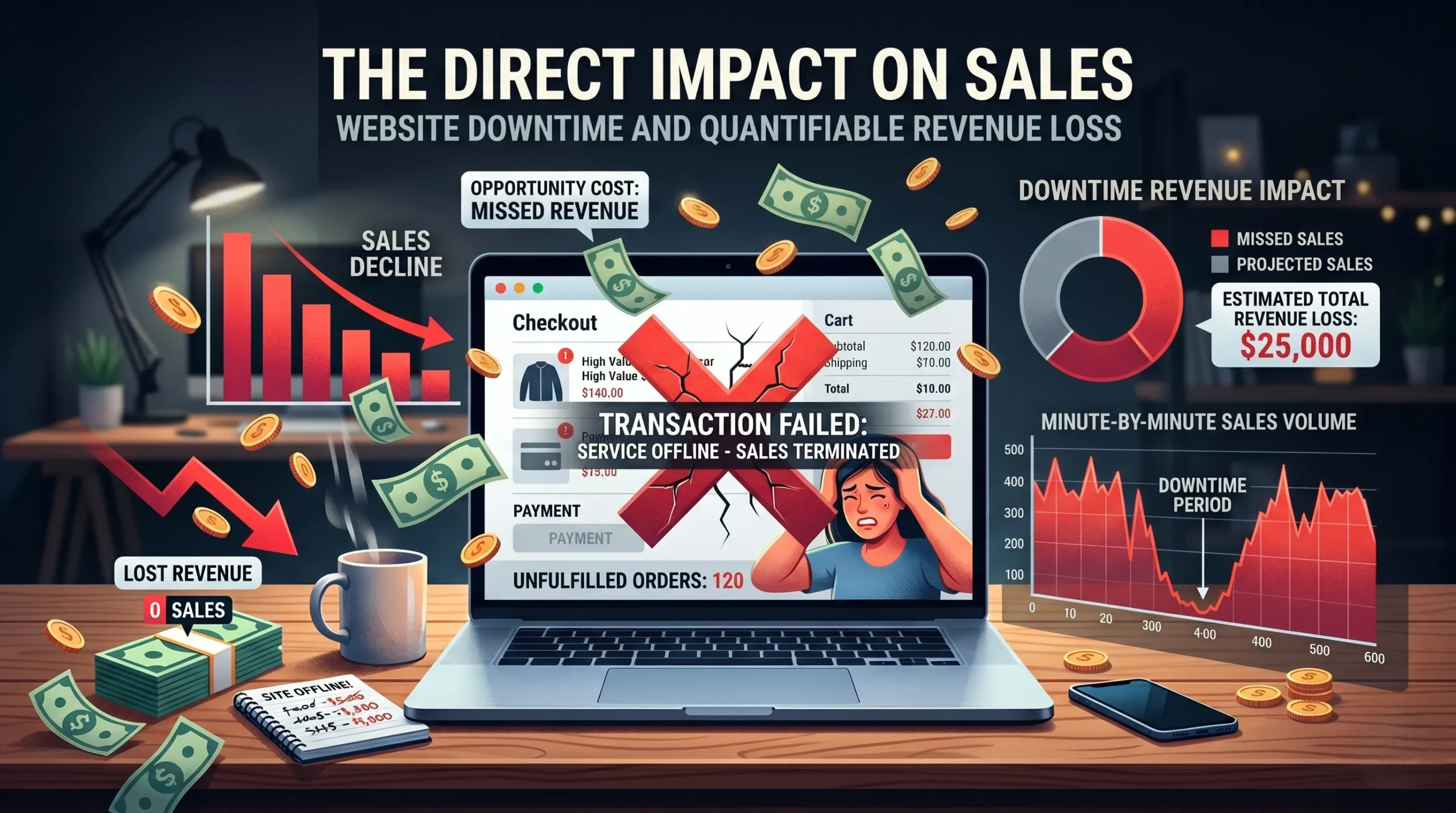
The most immediate and measurable consequence of website downtime is the loss of revenue. When your site is down, your cash register is effectively locked.
Immediate Revenue Loss
Every minute your site is inaccessible translates directly to lost dollars.
- Missed transactions: Customers ready to buy cannot complete their purchases.
- Abandoned carts: Shoppers who have already spent time selecting items will abandon their carts if the checkout process stalls.
- Lost leads: B2B companies miss out on crucial form submissions, quote requests, and email sign-ups, starving their sales pipelines.
Long-Term Financial Repercussions
The financial bleeding does not stop when the servers come back online.
- Decreased customer lifetime value: A buyer who experiences an outage during their first visit is highly unlikely to return. You lose not just a single sale, but years of potential repeat business.
- Higher customer acquisition costs: You spend heavily on marketing and advertising to drive traffic. If that traffic hits a dead page, your return on ad spend plummets, making it far more expensive to acquire a single paying customer.
- Negative impact on SEO rankings: Search engines want to provide a good experience for their users. If Google repeatedly tries to crawl your site while it is down, your rankings will drop, leading to a sustained decrease in organic traffic long after the technical issue is resolved.
Real-World Consequences
Consider a mid-sized e-commerce retailer generating $100,000 a day. A localized server failure that lasts just four hours during a peak shopping window can easily cost $20,000 in direct sales. Factor in the wasted ad spend driving traffic to the broken site, and the financial toll becomes staggering. Major brands have lost millions due to brief outages during high-stakes events like Black Friday, proving that no one is immune to the costs of poor infrastructure.
Erosion of Customer Trust and Brand Reputation
Money can be earned back, but trust is notoriously difficult to rebuild. Your website is often the first point of contact between your brand and a potential customer.
Customer Frustration and Dissatisfaction
Modern consumers expect instant gratification. An inability to access services or products creates immediate frustration. A negative user experience heavily influences how a person perceives your entire company. If they cannot trust your website to load, they will subconsciously question the quality of your products, your customer support, and your business practices.
Damage to Brand Image
Consistent website downtime paints your brand as unreliable and unprofessional.
- Perceived unreliability: Customers want to know you will be there when they need you. Frequent outages suggest instability.
- Negative social media mentions: Frustrated users quickly turn to platforms like X (formerly Twitter) and Facebook to complain. A localized technical glitch can quickly turn into a public relations crisis.
- Loss of competitive edge: Your competitors are always just one click away. If your site is down, you are practically handing your hard-earned customers over to rival businesses.
The Cost of Rebuilding Trust
Rebuilding a damaged reputation requires immense time, effort, and capital. You will need to invest heavily in public relations campaigns, offer steep discounts or apologies to win back alienated customers, and spend more on marketing to overcome the negative sentiment. Preventing the damage with a reliable host like HostOrbis is infinitely cheaper than trying to repair it later.
The Role of SEO in Preventing Sales Loss

Search engine optimization (SEO) is heavily reliant on website availability. Uptime is a fundamental technical SEO ranking factor.
How Downtime Affects Search Engine Rankings
Search engine bots constantly crawl the web to index new content and check the status of existing pages.
- Crawl budget waste: Search engines assign a specific “crawl budget” to your site. If bots hit server errors (like 500 or 503 codes) instead of actual content, your crawl budget is wasted.
- Reduced page indexing: Prolonged downtime prevents search engines from indexing your latest blog posts, product updates, or landing pages.
- Google’s perception of site quality: Google explicitly favors websites that offer excellent user experiences. Frequent downtime signals a poor user experience, prompting search algorithms to demote your site in favor of more stable competitors.
The Importance of Consistent Uptime for SEO
Maintaining an uptime of 99.9% or higher is critical for preserving your hard-earned search rankings. Consistent uptime ensures search engine bots can always access and evaluate your content, keeping your organic traffic flowing steadily.
Strategies to Mitigate SEO Damage
If you must take your site offline for emergency maintenance, use a 503 HTTP status code (Service Unavailable). This tells search engines that the downtime is temporary, preventing them from de-indexing your pages or penalizing your rankings. However, this is a stopgap measure. The true solution is minimizing outages entirely.
Proactive Measures to Prevent Downtime with HostOrbis
Hope is not a reliable technical strategy. Preventing website downtime requires a proactive approach and a robust technological foundation.
Choosing a Reliable Hosting Provider
Your web host is the bedrock of your online presence. HostOrbis provides an enterprise-grade infrastructure designed specifically for high availability. By utilizing redundant power supplies, advanced network routing, and state-of-the-art server hardware, HostOrbis minimizes the physical and network failures that plague lesser hosting providers.
Implementing Robust Security Measures
Because cyberattacks are a leading cause of outages, security must be prioritized.
- DDoS protection: HostOrbis deploys advanced filtering systems to detect and mitigate DDoS attacks before they can overwhelm your servers.
- Regular security audits: Continuous vulnerability scanning helps identify and patch security loopholes before hackers can exploit them.
- Malware scanning: Automated tools constantly monitor your file system for malicious code, quarantining threats automatically.
Regular Backups and Disaster Recovery
Even the best systems can face unforeseen catastrophes. HostOrbis implements automated, routine backups of your databases and site files. In the rare event of data corruption or a successful breach, a clear disaster recovery plan allows you to restore your site to a working state in minutes, rather than days.
Content Delivery Networks (CDNs)
A CDN distributes copies of your website’s static assets (images, CSS, JavaScript) across a global network of servers. When a user visits your site, they load these assets from the server physically closest to them. This dramatically improves page load speeds and reduces the strain on your primary hosting server, keeping your site stable during traffic spikes.
Load Balancing and Scalability Solutions
For growing businesses, traffic is rarely static. HostOrbis offers load balancing solutions that distribute incoming web traffic across multiple servers. If one server experiences high demand, the load balancer shifts traffic to other available servers, preventing bottlenecks and ensuring uninterrupted service.
Monitoring and Rapid Response
You cannot fix a problem you do not know exists. Visibility into your server’s health is critical.
The Necessity of 24/7 Website Monitoring
Website downtime doesn’t respect business hours. Your site needs continuous, automated monitoring that checks for uptime, server response times, and specific application functionality every single minute.
Alert Systems and Their Importance
When an issue occurs, key personnel must be notified instantly. Automated alert systems send SMS, email, or Slack notifications to your IT or management team the moment a metric falls outside acceptable parameters.
Having a Clear Incident Response Plan
Receiving an alert is only the first step. Your team must have a documented incident response plan outlining exactly who is responsible for troubleshooting, how to communicate with customers during the outage, and the steps required to restore service.
HostOrbis’s Monitoring and Support Services
HostOrbis takes the burden of monitoring off your shoulders. Their expert support team monitors server health around the clock. When anomalies are detected, HostOrbis technicians often resolve the underlying hardware or network issues before you even realize there was a potential problem.
The Hidden Costs of Downtime
Beyond immediate sales and reputation damage, website downtime inflicts hidden costs on your organization.
Employee Productivity Loss
When internal tools, web portals, or the main website go down, your employees cannot do their jobs. Marketing campaigns must be paused, customer support teams are flooded with complaints instead of handling standard queries, and sales teams cannot process orders. You are essentially paying your staff to wait for the servers to reboot.
IT Resource Drain
Unplanned outages force your IT department to drop whatever strategic projects they are working on and enter emergency firefighting mode. This disrupts development timelines and burns out technical staff.
Potential Legal and Compliance Issues
For e-commerce, healthcare, or financial businesses, downtime can lead to compliance violations. If an outage results in a data breach or prevents users from accessing critical financial records, you may face severe fines, legal action, and regulatory scrutiny.
Investing in Uptime: A Business Imperative
Viewing high-quality web hosting as a mere operational expense is a mistake. It is an investment in revenue protection.
Uptime as a Critical KPI
Uptime should be tracked as a core Key Performance Indicator (KPI) at the executive level. It is just as important as conversion rates or customer acquisition costs.
Calculating the Cost of Downtime
To understand the stakes, calculate your specific cost of downtime. Take your gross annual online revenue and divide it by the number of minutes in a year (525,600). This gives you your revenue per minute. Multiply that by the average number of minutes you expect to be down, and add the hourly cost of your IT staff and lost employee productivity. The final number is usually a wake-up call.
The ROI of Investing in Quality Hosting
When you calculate the true financial and reputational cost of an outage, the return on investment for premium hosting becomes obvious. Paying slightly more per month for HostOrbis’s redundant infrastructure and proactive monitoring pays for itself the very first time their systems prevent a major crash.
Secure Your Future
Website downtime is a pervasive threat that strikes at the heart of your business operations. It immediately halts sales, drains your marketing budget, plummets your search engine rankings, and erodes the hard-won trust of your customer base. The hidden costs of lost productivity and IT strain only compound the damage.
Protecting your digital assets requires more than good luck. It demands proactive measures, robust security protocols, and continuous monitoring. Partnering with a reliable hosting provider like HostOrbis equips your business with the resilient infrastructure necessary to weather traffic spikes, thwart cyberattacks, and maintain a seamless user experience.
Do not wait for a catastrophic failure to take action. Secure your online presence, protect your sales, and build lasting customer trust by upgrading your hosting infrastructure today.
Frequently Asked Questions (FAQ)
What is an acceptable level of website downtime?
Most enterprise-grade hosting providers aim for “Five Nines” (99.999% uptime), which equates to roughly 5 minutes of downtime per year. For standard businesses, 99.9% uptime is generally the accepted minimum standard, allowing for about 8.7 hours of downtime annually, mostly for scheduled maintenance.
How can I calculate the true cost of downtime for my business?
Calculate your gross online revenue per minute (Total Annual Online Revenue / 525,600). Multiply that by the duration of the outage in minutes. Then, add the hourly wages of employees who were unable to work, the cost of IT staff repairing the issue, and the estimated cost of wasted ad spend during the outage window.
Does HostOrbis help protect against DDoS attacks?
Yes. HostOrbis utilizes advanced network filtering and security protocols to detect and deflect DDoS attacks, ensuring malicious traffic does not overwhelm your server resources or take your website offline.
Can a temporary outage permanently ruin my SEO?
A short outage (under a few hours) is unlikely to cause permanent SEO damage, especially if you return a 503 status code. However, frequent, repeated outages, or downtime lasting several days, will cause search engines to de-index your pages and significantly drop your rankings.